Garage Door Off Track Repair in Farmington, MO
The door is braced, guided back onto the rails, and re-seated on straight track with healthy rollers; whatever caused the derailment is fixed as well, so it stays put.
A roller outside the track, a door that leans or jams, or a panel bowed where it snagged all mean the door is off track. For a home near Farmington that means one thing first: leave it alone and keep the opener switched off.
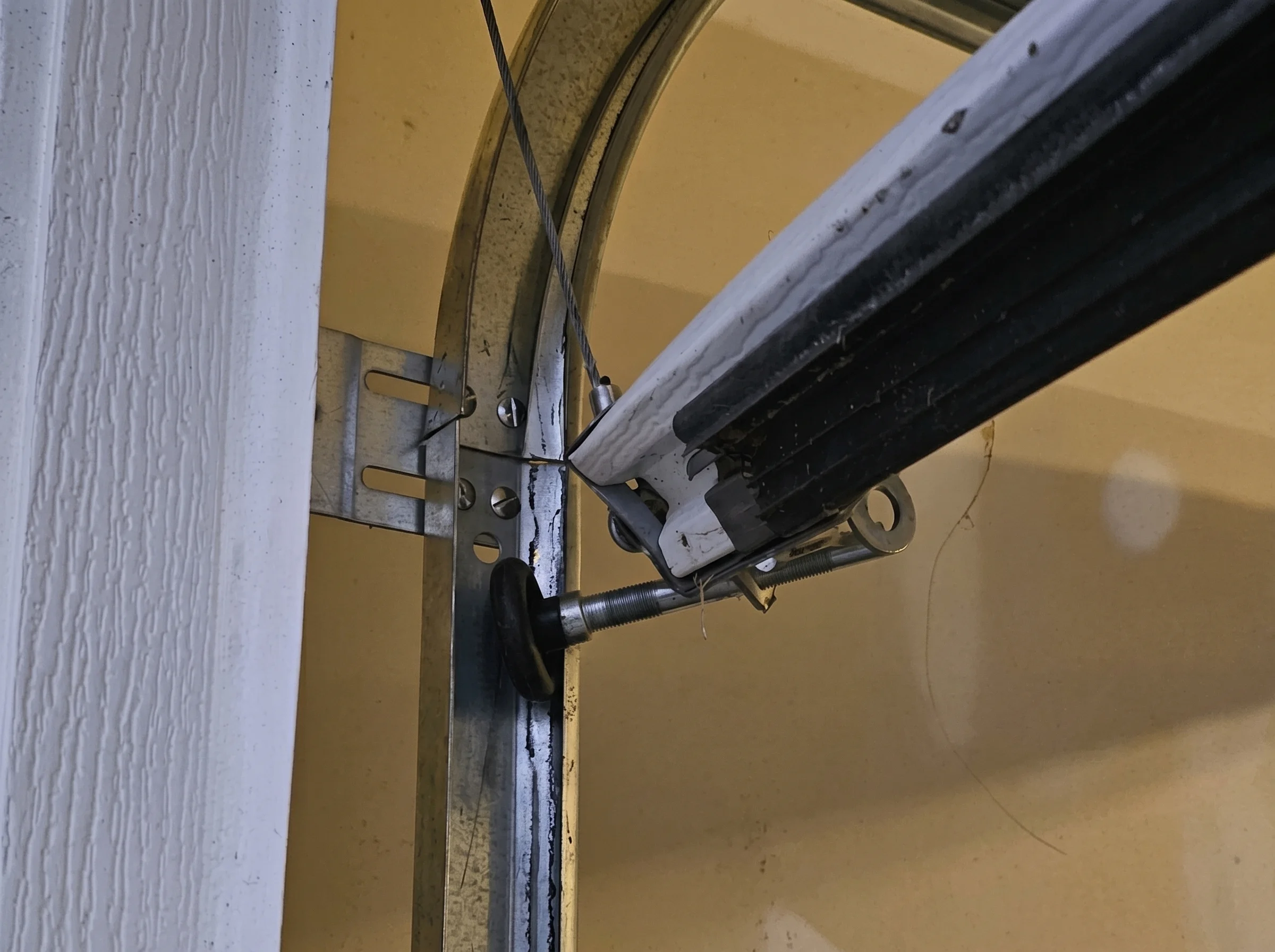
How to recognize a derailed door
A roller or two resting outside the rail, typically at floor level or around the bend where the track starts curving up to the ceiling.
A leaning or jammed door, often stopped halfway up.
A panel creased or bowed where the opener kept driving against the jam.
Rail that looks warped, crushed or detached from the wall.
Scraping, grinding or popping sounds just ahead of the derailment.
Door off its rails? Leave the opener alone, then tell us which side let go and what led up to it.
Contact UsHow a door ends up off its rails
A car tap
A bumper meeting a shut or half-raised door is the leading culprit, and the lower end of the rail often gets bent in the process.
A cable that let go
A corner falls, the door twists and wheels pop free. With a loose cable in the picture, the cable repair page deals with that part.
Rollers that are shot
Once a bearing seizes, the wheel skids rather than turns and hops out at the first rough patch.
Slack or twisted rail
Years of vibration loosen the brackets fastening the rail to the wall, and the gap slowly widens until a roller escapes.
An object under the door
A shovel, bike or lump of ice caught under the edge; Farmington averages 8.7 inches of snow a year.
First steps
Keep the opener off
It will keep pushing, bending panels and pulling the rail loose from the wall.
Leave the emergency release cord alone with the door partly up and derailed, because it may drop or swing free of the rail.
Don't hammer rollers back in while the door bears load. Spring tension is still active on a derailed door, so it can jerk suddenly.
Stand clear of the door, and say so when you get in touch if a car is stuck inside.
What the fix looks like
The door gets locked in position so it cannot drop or slide during the work, and any spring tension is managed first.
Damage gets sized up
Which rollers failed, how much rail is bent, whether panels are creased, and if a cable or spring triggered it.
Rail is trued or swapped out
Slight bends can be corrected; torn or creased rail sections are replaced.
Bad rollers are replaced, hinges are inspected, since a cracked hinge can fling a roller out again.
The door is lifted back onto the rails, brackets are tightened, and it is cycled fully on the opener. Force and travel settings get a second look at the end.
Describe what the door does
A few words will do: which side came out, whether anything hit it, and what you heard just before.
Rollers
Rollers decide how smoothly a door runs, and with roughly 111 wet days a year in Farmington they tire before the door does.
Steel rollers with no bearings are the simplest kind. They're loud and they chew up the rail as they roll.
Sealed-bearing nylon rollers glide much more quietly and ask for hardly any oil or attention.
Wobble, flat spots, cracks or a locked bearing show a roller has reached its limit.
A door that is merely noisy, not damaged, often needs little beyond fresh rollers, which commonly happen during a maintenance visit.
What shapes the price of fixing a derailment
Extent of the derailment
Two wheels at a corner versus a door swinging free.
Rail damage
Straighten or replace sections, on one or both rails.
Rollers and hinges that are shot.
Creased or split door panels
A panel bent too far may have to be replaced, and finding a match for an older door can be tough.
A failed cable or spring that came first.
If a panel is beyond saving
After a hard impact, a panel may be bent past repair. One panel can frequently be swapped while the remainder of the door stays, provided the maker still sells that style.
If not, or if several are damaged, see garage door installation, and ask whether Farmington requires a permit.
Quick answers
Is it okay to pop the rollers back in on my own?
Sometimes, when one roller has slipped out low on a closed door and neither the rail nor a cable is damaged. Beyond that, stop: the door is heavy, spring-loaded and likely to move without warning, so it isn't worth the risk.
What makes the same side jump the rail repeatedly?
The usual suspects are a rail nudged out of line, a slack bracket, or a cable on that side needing adjustment. Putting the door back without treating the cause invites a repeat.
Do the rails need lubricant?
No. Rails should stay clean and dry, because oil there picks up grit. Roller bearings, hinges and springs are the places for lubricant.
More garage door topics
Garage Door Cable Repair
Lift cables that fray or come loose, and a door hanging at an angle.
Read more →Garage Door Spring Repair
Snapped spring replacement, torsion or extension, sized to what your door weighs.
Read more →Garage Door Installation
Replacement doors in steel, wood, composite or glass, built to match your opening.
Read more →Contact us
Say where the door stopped, whether closed, open or halfway, which side left the rail, what might have struck it, and if a cable seems slack.
The most helpful thing to send is a picture of each side taken from several feet back.